Showing posts with label Occupational Medicine. Show all posts

Wednesday, June 5, 2013

Publicatie van de Week: "Occupational Health Guidelines for the management of low back pain: an international comparison" van JB Staal et al. (2013)

Recent publiceerde OEM "Occupational Health Guidelines for the management of low back pain: an international comparison", een artikel van de hand van JB Staal en collega's. 
Belangrijkste boodschappen
 
Abstract
 Download volledige artikel hier

Wednesday, May 29, 2013

Publicatie van de Week: "The attitude of Flemish occupational health physicians toward evidence-based occupational health and clinical practice guidelines" van Heselmans et al. (2010)

Deze week een publicatie van eigen bodem. Heselmans et al. publiceerden in Int Arch Occup Environ Health een artikel over de houding van de Vlaamse arbeidsgeneesheer ten aanzien van de EVOM en richtlijnen.
De grootste tekortkoming van deze publicatie is de zeer magere respons rate (25,5%). Het is dan ook moeilijk om de resultaten te beoordelen.
Questionnaire used was to identify:
  1. attitude towards EBOM
  2. perceived knowledge on EBM
  3. views on perceived barriers to practicing EBOM
  4. attitude towards Clinical practice guidelines (CPGs)
Belangrijkste tabel
Abstract

Wednesday, May 22, 2013

Publicatie van de Week: "When Work is Related to Disease, What establishes Evidence for a Causal Relation" van J. Verbeek (2012)

Nogmaals een artikel van de hand van de auteur Jos Verbeek. Dit maal een recente publicatie gepubliceerd in Safety and Health @ Work (Saf Health Work 2012; 3: 110-6)
Establishing a work-related cause of a disease is one of the most challenging aspects of occupational medicine.
An occupational disease is any disease that results from exposure at work.
There are 3 important elements in this definition that call for evidence: disease, exposure, and the relationship between these 2.
Conclusion:
For the disease, consensus on symptoms, signs and other tests is needed.
For the exposure, evidence is needed that the used measures correspond well to objective exposure assessment.
There are no absolute criteria for evidence of causality in observational epidemiological studies.

2 Cases are presented: 
  1.  Shift work and breast cancer
  2. Aerotoxic syndrome 


Abstract

Download volledige publicatie @ SH@W (Safety and Health at Work)

Wednesday, May 15, 2013

Publicatie van de Week: "Evidence-based medicine for occupational health" van JH Verbeek et al. (2002)

In 2002 verscheen er een Clinical Questions artikel van de hand van Jos Verbeek & Co. waarin 4 vaak voorkomende vragen binnen de arbeidsgeneeskundige context worden bekeken vanuit een EBM visie, in Scand J Work Environ Health (2002; 28 (3): 197-204).
Download publicatie hier
  1. Beeldschermwerk en branderige ogen
  2. Rioolwerk en hepatitis A
  3. Effectieve behandeling van burnout en reïntegratie
  4. Werk en hypertensie tijdens zwangerschap
Op het artikel volgende een Letter to the Editor "Evidence in occupational medicine" van AI Larsen & JR Jespen (Scand J Work Environ Health 2002; 28 (5): 358-359) en een Author's Reply in Scand J Work Environ Health 2002; 28 (5): 359-360.
Download beide artikeltjes hier:
Larsen & Jespen
Author's Reply  
G. Franco schreef in 2003 een Letter to the editor "Evidence-based medicine and evidence-based occupational health", gepubliceerd in Scand J Work Environ Health 2003; 29 (1): 78-79.
Het evidence-based model focust op EXPERTISE verkregen door de volgende 3 onderliggende elementen: 

  1. Clinical state & circumstances (= availibility of resources, sociocultural environment, local burden of diseases, risk factors)
  2. Patients' preferences, values, and actions 
  3. Research evidence (the research for evidence in occupational health differs, both in the evidence-searching stage and in the evidence appraisal stage, from clinical research !! // the model for EBM is founded on evidence provided by randomized controlled trials)
The occupational health physician must have skills to identify the problem in its context correctly, to involve other stakeholders successfully in the decision process, and to find, appraise and apply the evidence in practice.

Thursday, May 9, 2013

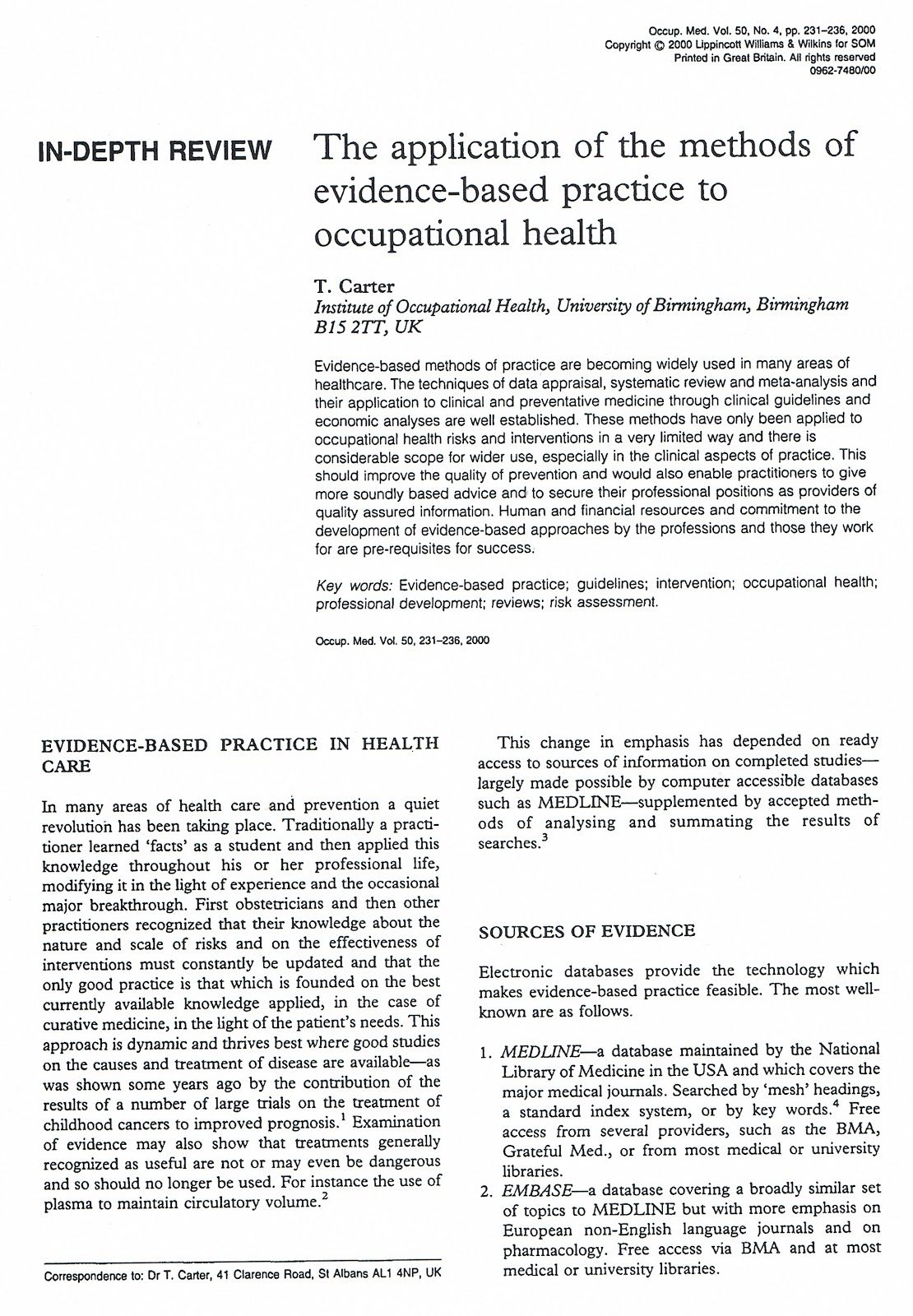
Publicatie van de Week: "The application of the methods of evidence-based practice to occupational health" (2000) van T. Carter

Abstract
Download het volledige artikel hier.

Bronnen van evidentie
  1. MEDLINE (National Library of Medicine, USA) 
  2. EMBASE (meer aandacht voor niet-Engelstalige, Europese publicaties)  
  3. Cochrane Reviews (databases met index reviews)
  4. World Wide Web
  5. "Grey Literature" (congresnota’s, theses, officiële rapporten,...)
  6. Tekstboeken 
  7. Medische (Universitaire) bibliotheek
Evidence-based products 
  1. Critical appraisal (kwaliteit nagaan van een publicatie op een gestructureerde wijze)
  2. Systematic review (review met inclusie/exclusie criteria)
  3. Meta-analysis
  4. Clinical guideline / Good practice recommendation (gebaseerd op systematische reviews en meta-analyses)
  5. Economic analysis

Saturday, April 20, 2013

Start me up - Start me up - Start me up

Weldra zullen hier interessante arbeidsgeneeskundige sprokkels gepubliceerd worden.
Hopelijk bezoekt u deze blog in de nabije toekomst regelmatig.
Beginselverklaring: Deze blog wil zijn bedrage leveren aan het tot stand komen van een evidence-base occupational medicine in de Vlaamse contreien. Dit volgens de Do It Yourself (DIY) en You Are In Control (YAIC) principes.
Zowel onze strategie als missie zijn gebaseerd op een triade.
Onze strategie is die van de filosoof Georg Wilhelm Friedrich Hegel: "Thesis, Antithesis, Synthesis".
Onze missie: "The Good, The Bad and The Otherwise Difficult" werd ontleend aan de Editoriaal verschenen in Occupational Medicine (2000; Vol. 50, No 4: 211) van de hand van Dr Denis D'Auria.